
"*" indicates required fields
Take a look at our FAQ. We’ve got plenty of helpful tips and answers waiting for you.
Most mobility scooters and power chairs use two long-lasting, sealed, deep-cycle batteries. These batteries are maintenance-free, so you do not need to check electrolyte levels.
Deep-cycle batteries are designed for longer and deeper discharges than standard vehicle batteries. Vehicle batteries are not suitable for mobility devices because they are not designed to handle extended use and deep discharges.
For optimal performance and longevity:
Always use two batteries of the same type, chemistry, and amp-hour (Ah) rating.
Use the charger provided with your mobility device, as it is designed specifically for safe, efficient charging.
Most mobility devices use off-board chargers, which are separate from the scooter or power chair. To charge safely:
Position your mobility device next to a standard electrical outlet.
Make sure the controller is turned off.
Plug the charger into the device’s charging socket.
Plug the charger into the electrical outlet.
When the batteries are fully charged, unplug the charger first from the outlet, then from the device.
Many chargers have LED indicators showing power on, charging in progress, or charging complete. If your device does not fully charge within 24 hours, unplug the charger and contact your dealer.
New batteries require a few charging cycles to achieve peak performance and long life:
Fully charge any new battery before initial use to reach approximately 90% of its capacity.
Operate the device slowly at first, indoors or in a safe area, to break in the batteries.
Recharge fully for 8–14 hours and use again.
After 4–5 charging cycles, your batteries should reach 100% capacity and deliver maximum performance.
How often you charge depends on usage:
Daily users: Charge the batteries after each day’s use for 8–14 hours.
Occasional users: Charge twice a week for 8–14 hours to maintain battery health.
Do not exceed 14 hours of continuous charging to avoid overcharging.
Following these guidelines ensures your mobility scooter or power chair maintains peak performance and extends battery life.
The battery in your mobility scooter powers your ride, but what powers the battery? Most modern mobility scooters use rechargeable batteries that come with off-board chargers. Similar to a mobile phone, your scooter plugs into a wall outlet to charge, and the energy is stored in the battery for later use.
We will explain the difference between on-board and off-board chargers and how different chargers can impact how far your scooter can travel.
An off-board charger is separate from your scooter. It usually consists of a small black box with two cords: one that plugs into a wall outlet and another that plugs into your scooter. The size and shape vary depending on the battery and charger specifications.
Wall outlets supply alternating current (AC) power. AC power travels from the electricity grid into your home. Household items such as fans, microwaves, or hairdryers run on AC power.
Direct current (DC) power, on the other hand, cannot travel long distances, so it is stored in a battery. DC power delivers a steady voltage, making it ideal for electronics such as mobility scooters.
The off-board charger converts AC power from the wall into DC power, which is stored in the battery and ready to power your scooter.
An on-board charger performs this conversion inside the scooter itself. You simply plug the scooter into the wall, and the AC power is converted and stored as DC power without the need for an external charger.
No. The type of charger and battery will vary depending on the scooter. Chargers typically range from 2 to 8 amps. Higher amps mean faster charging.
Battery capacity and charger type directly affect the range of your scooter. For example:
Small batteries with low-amp chargers are suitable for short-range travel, typically 15–20 km per charge.
Medium batteries with moderate-amp chargers can provide 25–35 km per charge.
Larger batteries with high-amp chargers may allow travel of 40 km or more, depending on the weight of the rider and scooter.
Other factors, such as terrain, speed, and rider weight, can also affect range.
Many modern scooters use lithium-ion batteries, which are lighter, smaller, and more efficient than traditional sealed lead-acid batteries. Lithium batteries store more power for their size and can often be charged using either on-board or off-board chargers.
Sealed lead batteries are heavier but still provide reliable power for most standard scooters. Choosing the right battery type depends on how far you intend to travel, portability needs, and personal preference.
Looking at a lineup of Pride Mobility products, the different sizes, shapes, and tire configurations stand out. Some tires are filled with air, while others are solid. Some are filled with foam, and others are perforated.
First, we’ll describe the two types of tires, then explain why different models require different setups.
Pneumatic tires are rubber tires filled with air. They provide better traction and a smoother ride than solid tires. Pneumatic tires are more efficient, allowing the vehicle to maximise speed and range. They also slip less and stop faster.
Because they are air-filled, pneumatic tires require regular maintenance. Users need to check air pressure and occasionally repair punctures. Pneumatic tires can be either tube-type, like a bicycle tire, or tubeless, like a car tire. If a tube-type tire is punctured, the tube can usually be replaced while reusing the rubber tire. Tubeless pneumatic tires may need full replacement if punctured.
Solid tires are airless. They can be fully solid or filled with materials like polyurethane or foam. Most Pride Mobility devices use solid tires. These tires won’t go flat, so there’s no need for a tire gauge or air compressor. The low maintenance makes solid tires ideal for daily-use wheelchairs or scooters.
While solid tires have less cushioning than air-filled tires, the design of Pride devices often compensates with sturdy suspension or additional wheels.
Weather can change in an instant. You may be out with your mobility scooter or power chair and suddenly caught in rain or snow. Even once the storm has passed, large puddles or snow on the paths may still be a problem. It is important to understand how water affects your mobility product. By acting quickly after exposure to water, you can help protect its performance and lifespan.
When faced with sudden rain or snow:
Find shelter if possible until the weather improves.
Avoid deep puddles or wet, muddy areas.
Remember that your mobility product contains electronic components. Prolonged contact with water can cause malfunctions, corrosion of electronics, and rust on the frame.
Dry your mobility scooter or power chair thoroughly with a towel as soon as possible.
Wipe down all surfaces carefully.
Leave the product in a warm, dry place for at least 12 hours to allow any unseen moisture to evaporate.
Check the joystick and brakes before using it again.
If you notice any issues, contact your dealer or service provider for advice.
It is also a good idea to regularly inspect your product for signs of corrosion or damage caused by water exposure. Any affected parts should be treated or replaced immediately in consultation with your dealer.
Carry a plastic bag or protective cover with you. If a sudden shower occurs, you can cover the joystick or controller to protect it.
Check the weather forecast before leaving home. If wet weather is expected, consider adjusting your plans or waiting until later.
By understanding the effects of moisture and taking simple steps to limit exposure, you can ensure your mobility scooter or power chair stays in top condition. This way, you can continue to enjoy reliable performance and independence, whatever the weather.
When you think of a power chair, you probably imagine a sleek wheelchair gliding smoothly across the floor. That is, of course, the primary function of a mobility device. But with the right power chair, you can do so much more.
One key feature is elevation. With an elevating power chair, users can easily raise and lower the seat. This provides access to higher objects and allows for eye-level interactions with others.
The Jazzy Air 2 is an excellent choice for anyone who wants to navigate their home or explore the world with ease.
Key Features:
Maximum weight capacity: 136 kg
Range per charge: up to 31 km
Maximum speed: 6,4 km/h, regardless of seat height
Ride quality: Mid-Wheel 6 technology with Active-Trac suspension
Comfort: Adjustable armrests and headrest
Lighting: LED lights for safe travel in low-light conditions
Elevation: Seat rises up to 305 mm in just 11 seconds
Turning radius: 528 mm, perfect for tight indoor spaces
The Jazzy Air 2 is designed for users who spend much of their day seated. Its tight turning radius makes it ideal for navigating around the home, popping into shops, or enjoying a meal with friends.
Elevating power chairs provide vertical mobility, which can be life-changing. Even a small lift can make a big difference in daily activities.
Traditional home layouts can be challenging for wheelchair users. High cabinets, microwaves, and other appliances may be difficult to access. With the Jazzy Air® 2, you can elevate smoothly to reach cupboards, appliances, or laundry machines without straining.
Eye contact is essential for forming personal connections. Without an elevating chair, conversations may feel physically and socially unbalanced. Elevating chairs help users meet others at eye level, improving communication and reducing power imbalances in professional or social settings.
The Jazzy Air® 2 allows users to adjust seat height while moving. You can elevate en route to a destination or lift yourself up when approaching a group, ensuring seamless interaction and convenience throughout your day.
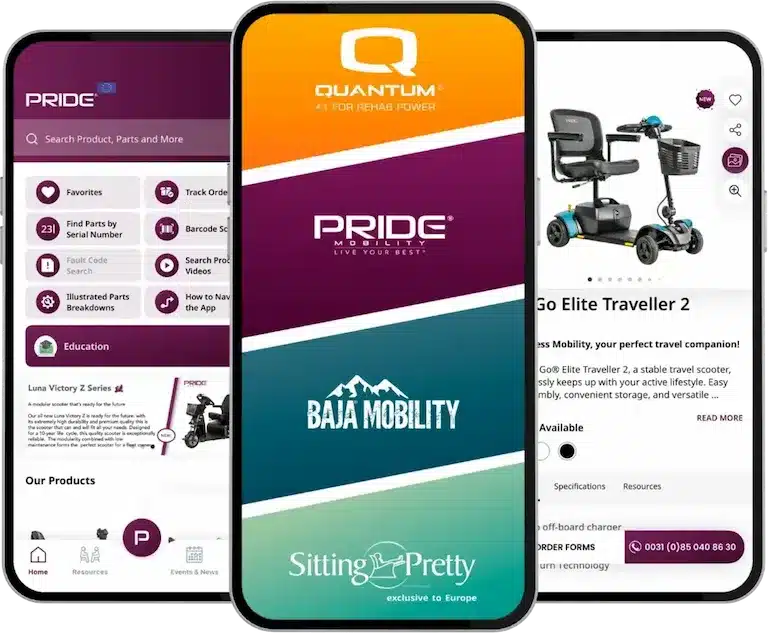
Get instant access to products, manuals, order tracking, and more with the PQ-365 app. Download the Pride Mobility app today.