
"*" indicates required fields
Take a look at our FAQ. We’ve got plenty of helpful tips and answers waiting for you.
Welcome to the exciting world of mobility innovation! Whether you are looking for a new mobility scooter or supporting customers as a dealer, you may have already heard about one of the latest breakthroughs in scooter design: EZ Turn Technology.
This patented feature is transforming the way users experience manoeuvrability, combining the stability of a four-wheel scooter with the tight turning radius of a three-wheel model. In this blog, we’ll explore what EZ Turn Technology is, its key benefits, and why the Go Go Elite Traveller 2 4-Wheel is a true game-changer.
The Basics
EZ Turn Technology is Pride Mobility’s patented innovation that gives riders the best of both worlds: four-wheel stability with three-wheel agility.
How It Works
The front wheels pivot independently, creating an ultra-tight turning radius. This makes it easier to navigate narrow hallways, crowded shops, and other tight spaces.
Why It Matters
For many mobility scooter users, everyday manoeuvring can be one of the biggest challenges. EZ Turn reduces stress and effort, giving you more confidence and freedom.
Smallest Turning Radius – Just 94 cm (37 inches), industry-leading among four-wheel scooters.
Stability + Manoeuvrability – Smooth, safe rides without compromising on agility.
Customisable Appearance – Comes standard with Cardinal Red and Black shrouds, plus six optional colour sets for a personal touch.
Weight Capacity – 136 kg
Top Speed – Up to 6,4 km/h
Range – Up to 22 km with an 18 Ah battery, or up to 14 km with a 12 Ah battery
Feather-Touch Disassembly – Separates into five lightweight pieces for easy transport
Adjustable Delta Tiller – With built-in charging port
Flat-Free, Non-Scuffing Tyres – Durable and safe for indoor and outdoor use
Convenience – Comes with a front basket and armrest storage bag as standard
Nothing compares to experiencing EZ Turn for yourself. Visit your local Pride Mobility dealer to schedule a test ride and feel the difference in comfort, manoeuvrability, and stability.
Keep the battery fully charged and check connections regularly.
Inspect tyres for wear and ensure they remain in good condition.
Clean the scooter frequently to maintain performance and extend its lifespan.
The Go Go Elite Traveller 2 4-Wheel with EZ Turn Technology represents a major step forward in mobility solutions. With exceptional agility, stability, and style, it’s designed to make daily life easier and more enjoyable.
Whether at home, in the city, or exploring new places, this scooter delivers performance you can rely on. Discover more about the Go Go Elite Traveller 2 and explore our full range of mobility solutions at Pride Mobility Products Europe.
Your adventure awaits!
All-terrain mobility scooters offer freedom and independence, helping people with mobility challenges to explore and enjoy a wide variety of environments. From rough country paths to grassy fields, these scooters open up possibilities that traditional models simply cannot match.
However, not every all-terrain scooter is built the same. Choosing the right one depends on your lifestyle, mobility needs, and the type of terrain you plan to cover. In this guide, we’ll explore what makes an all-terrain scooter different, who can benefit the most, and the key factors to look out for.
An all-terrain mobility scooter is designed to handle outdoor environments that are more challenging than smooth pavements or indoor floors. With larger wheels, stronger motors, and suspension systems, they can tackle:
Gravel or dirt paths
Grass and fields
Uneven ground
Mild off-road conditions
This makes them far more versatile than traditional scooters, which are usually designed for level, urban surfaces.
Outdoor enthusiasts who enjoy parks, nature trails, or countryside settings
Rural residents who regularly travel across gravel driveways, farmland, or unpaved roads
Active seniors who want to stay mobile and independent in varied environments
People with practical needs, such as farmers or gardeners, who require mobility support across uneven terrain
Although primarily designed for outdoor use, many all-terrain scooters can be used indoors. Keep in mind, however, that their larger size and weight can make manoeuvring in tight indoor spaces more difficult compared to smaller, compact models.
Like all mobility devices, all-terrain scooters need regular care to stay safe and reliable. This includes:
Checking tyre pressure and condition
Lubricating moving parts
Keeping the battery charged and well maintained
Following the manufacturer’s service guidelines
For best results, schedule professional servicing when required and keep the scooter clean to extend its lifespan.
Some all-terrain scooters are designed with portability in mind, making them easier to take on trips. These can often be:
Disassembled or folded for car travel
Lightweight enough for easier handling
Suitable for planes, buses, or trains (check regulations in your country before travelling)
When choosing a portable all-terrain scooter, consider:
Weight capacity – Ensure it can support your needs, including any accessories
Battery range – Look for a model that covers your daily travel distance comfortably
Dimensions when folded/disassembled – Check that it fits into your car boot or travel case
For those who want both ruggedness and portability, lightweight all-terrain scooters are a great option. They are made with lighter materials but still feature:
Suspension systems for comfort
Pneumatic tyres for better grip and shock absorption
Strong performance across grass, gravel, and uneven terrain
One example is the Baja Bandit, an 12,8 km/h all-terrain travel scooter with adjustable suspension, robust tyres, and a balance between stability and portability.
When deciding on your ideal model, think about:
How and where you’ll use it most often
Ease of transport and storage
Comfort features (suspension, seat adjustability, handlebar style)
Style and personal preferences
Does your lifestyle call for an all-terrain mobility scooter? Pride Mobility offers a wide selection designed to match different needs and preferences. Browse our full range online or get in touch for personalised advice.
We’re here to help you find the perfect scooter for your independence and adventures.
Travelling with a mobility scooter can open up a world of opportunities, but careful planning is essential to make your journey smooth and enjoyable. Portability, preparation, and awareness of accessibility are key to a stress-free experience.
Choose a Portable Mobility Scooter
Select a scooter that suits your travel needs. Consider weight, size, battery range, and ease of folding or disassembly. A lightweight, compact, and easily manoeuvred model is ideal for travelling.
Check Travel Regulations
Different airlines, trains, buses, and cruise lines have specific rules for transporting mobility scooters. Research requirements for battery types, size limits, documentation, and certification in advance to avoid delays.
Plan Your Itinerary
Prioritise destinations and activities that are wheelchair- and scooter-friendly, with smooth pathways, ramps, and accessible facilities. This ensures you can explore comfortably and safely.
Arrange Assistance if Needed
Notify airlines, hotels, or tour operators of your mobility needs in advance. Request wheelchair assistance, accessible rooms, or transport services if necessary, to guarantee a smooth travel experience.
Flying with a Mobility Scooter
Inform your airline about your scooter, including dimensions, weight, and battery type. Many airlines require batteries to be disconnected and terminals taped for safety. Gate delivery options allow you to use your scooter until boarding and have it returned at your destination.
Trains and Buses
Check with providers about ramps, lifts, and wheelchair spaces. Secure your scooter with straps or tie-downs as required, and familiarise yourself with the process to ensure a stable journey.
Cruises
Look for accessible cabins with wide doorways, roll-in showers, and sufficient space for manoeuvring. Cruise ships often provide elevators, ramps, and wheelchair-friendly routes.
Accessible Accommodations
Choose hotels or rental properties that offer accessible entrances, pathways, and rooms. Ensure doorways, bathrooms, and circulation spaces meet your scooter’s requirements.
Communicate Your Needs
Contact accommodation providers in advance to confirm accessibility arrangements. Don’t hesitate to request additional support during your stay.
Sightseeing and Activities
Look for accessible attractions, tours, and activities. Use official websites for accessibility information, and consider alternative options like accessible taxis, shuttles, or guided tours where needed.
Safety and Comfort
Avoid rough, uneven terrain and be mindful of environmental conditions. Stay hydrated, pace yourself, and take regular breaks to prevent fatigue.
Keep batteries fully charged and check your scooter before each journey.
Pack essential items, documents, and medications in an accessible bag on your scooter.
Communicate clearly with transport and accommodation staff to ensure your needs are met.
Enjoy your travels and make the most of the freedom your mobility scooter provides!
Most mobility scooters and power chairs use two long-lasting, sealed, deep-cycle batteries. These batteries are maintenance-free, so you do not need to check electrolyte levels.
Deep-cycle batteries are designed for longer and deeper discharges than standard vehicle batteries. Vehicle batteries are not suitable for mobility devices because they are not designed to handle extended use and deep discharges.
For optimal performance and longevity:
Always use two batteries of the same type, chemistry, and amp-hour (Ah) rating.
Use the charger provided with your mobility device, as it is designed specifically for safe, efficient charging.
Most mobility devices use off-board chargers, which are separate from the scooter or power chair. To charge safely:
Position your mobility device next to a standard electrical outlet.
Make sure the controller is turned off.
Plug the charger into the device’s charging socket.
Plug the charger into the electrical outlet.
When the batteries are fully charged, unplug the charger first from the outlet, then from the device.
Many chargers have LED indicators showing power on, charging in progress, or charging complete. If your device does not fully charge within 24 hours, unplug the charger and contact your dealer.
New batteries require a few charging cycles to achieve peak performance and long life:
Fully charge any new battery before initial use to reach approximately 90% of its capacity.
Operate the device slowly at first, indoors or in a safe area, to break in the batteries.
Recharge fully for 8–14 hours and use again.
After 4–5 charging cycles, your batteries should reach 100% capacity and deliver maximum performance.
How often you charge depends on usage:
Daily users: Charge the batteries after each day’s use for 8–14 hours.
Occasional users: Charge twice a week for 8–14 hours to maintain battery health.
Do not exceed 14 hours of continuous charging to avoid overcharging.
Following these guidelines ensures your mobility scooter or power chair maintains peak performance and extends battery life.
The battery in your mobility scooter powers your ride, but what powers the battery? Most modern mobility scooters use rechargeable batteries that come with off-board chargers. Similar to a mobile phone, your scooter plugs into a wall outlet to charge, and the energy is stored in the battery for later use.
We will explain the difference between on-board and off-board chargers and how different chargers can impact how far your scooter can travel.
An off-board charger is separate from your scooter. It usually consists of a small black box with two cords: one that plugs into a wall outlet and another that plugs into your scooter. The size and shape vary depending on the battery and charger specifications.
Wall outlets supply alternating current (AC) power. AC power travels from the electricity grid into your home. Household items such as fans, microwaves, or hairdryers run on AC power.
Direct current (DC) power, on the other hand, cannot travel long distances, so it is stored in a battery. DC power delivers a steady voltage, making it ideal for electronics such as mobility scooters.
The off-board charger converts AC power from the wall into DC power, which is stored in the battery and ready to power your scooter.
An on-board charger performs this conversion inside the scooter itself. You simply plug the scooter into the wall, and the AC power is converted and stored as DC power without the need for an external charger.
No. The type of charger and battery will vary depending on the scooter. Chargers typically range from 2 to 8 amps. Higher amps mean faster charging.
Battery capacity and charger type directly affect the range of your scooter. For example:
Small batteries with low-amp chargers are suitable for short-range travel, typically 15–20 km per charge.
Medium batteries with moderate-amp chargers can provide 25–35 km per charge.
Larger batteries with high-amp chargers may allow travel of 40 km or more, depending on the weight of the rider and scooter.
Other factors, such as terrain, speed, and rider weight, can also affect range.
Many modern scooters use lithium-ion batteries, which are lighter, smaller, and more efficient than traditional sealed lead-acid batteries. Lithium batteries store more power for their size and can often be charged using either on-board or off-board chargers.
Sealed lead batteries are heavier but still provide reliable power for most standard scooters. Choosing the right battery type depends on how far you intend to travel, portability needs, and personal preference.
You’ve decided to purchase a mobility scooter. Aan important step towards enhancing your independence. But with so many types of scooters available, how do you know which one is right for you?
When choosing a mobility scooter, it’s helpful to ask yourself a few key questions:
Do I want a 3-wheel scooter or a 4-wheel scooter?
How will I use my scooter. Mostly indoors or outdoors?
How fast do I want my scooter to go?
How far do I want to travel on a single charge?
A 3-wheel scooter offers benefits such as a sharper turning radius and more legroom, making it ideal for taller individuals. These scooters are often better suited for smooth indoor surfaces.
In contrast, 4-wheel scooters provide a wider and more stable wheelbase, ensuring better weight distribution and stability. They are well-suited for outdoor use, offering a comfortable and secure ride over varied terrain.
If you plan to use your scooter mainly indoors, look for models with a tight turning radius, like the Zero Turn 8 or the Go Go Elite Traveller. These scooters easily fit through doorways and navigate corners.
For outdoor use, choose a scooter that is rugged, comfortable, and capable of handling different surfaces, from pavements to uneven terrain.
Some users prioritise speed, while others focus on safety features. If visibility is important, look for scooters with LED lights, which improve safety when using your scooter in low-light conditions.
Range is another key consideration. Most scooters are battery-powered, so think about how far you want to travel on a single charge. Ensure the scooter you choose can cover your typical routes comfortably.
Still unsure which scooter is right for you? Visit a local Pride Mobility dealer and take a test drive. Experiencing the scooter first-hand is the best way to find the model that perfectly fits your needs.
Looking at a lineup of Pride Mobility products, the different sizes, shapes, and tire configurations stand out. Some tires are filled with air, while others are solid. Some are filled with foam, and others are perforated.
First, we’ll describe the two types of tires, then explain why different models require different setups.
Pneumatic tires are rubber tires filled with air. They provide better traction and a smoother ride than solid tires. Pneumatic tires are more efficient, allowing the vehicle to maximise speed and range. They also slip less and stop faster.
Because they are air-filled, pneumatic tires require regular maintenance. Users need to check air pressure and occasionally repair punctures. Pneumatic tires can be either tube-type, like a bicycle tire, or tubeless, like a car tire. If a tube-type tire is punctured, the tube can usually be replaced while reusing the rubber tire. Tubeless pneumatic tires may need full replacement if punctured.
Solid tires are airless. They can be fully solid or filled with materials like polyurethane or foam. Most Pride Mobility devices use solid tires. These tires won’t go flat, so there’s no need for a tire gauge or air compressor. The low maintenance makes solid tires ideal for daily-use wheelchairs or scooters.
While solid tires have less cushioning than air-filled tires, the design of Pride devices often compensates with sturdy suspension or additional wheels.
Weather can change in an instant. You may be out with your mobility scooter or power chair and suddenly caught in rain or snow. Even once the storm has passed, large puddles or snow on the paths may still be a problem. It is important to understand how water affects your mobility product. By acting quickly after exposure to water, you can help protect its performance and lifespan.
When faced with sudden rain or snow:
Find shelter if possible until the weather improves.
Avoid deep puddles or wet, muddy areas.
Remember that your mobility product contains electronic components. Prolonged contact with water can cause malfunctions, corrosion of electronics, and rust on the frame.
Dry your mobility scooter or power chair thoroughly with a towel as soon as possible.
Wipe down all surfaces carefully.
Leave the product in a warm, dry place for at least 12 hours to allow any unseen moisture to evaporate.
Check the joystick and brakes before using it again.
If you notice any issues, contact your dealer or service provider for advice.
It is also a good idea to regularly inspect your product for signs of corrosion or damage caused by water exposure. Any affected parts should be treated or replaced immediately in consultation with your dealer.
Carry a plastic bag or protective cover with you. If a sudden shower occurs, you can cover the joystick or controller to protect it.
Check the weather forecast before leaving home. If wet weather is expected, consider adjusting your plans or waiting until later.
By understanding the effects of moisture and taking simple steps to limit exposure, you can ensure your mobility scooter or power chair stays in top condition. This way, you can continue to enjoy reliable performance and independence, whatever the weather.
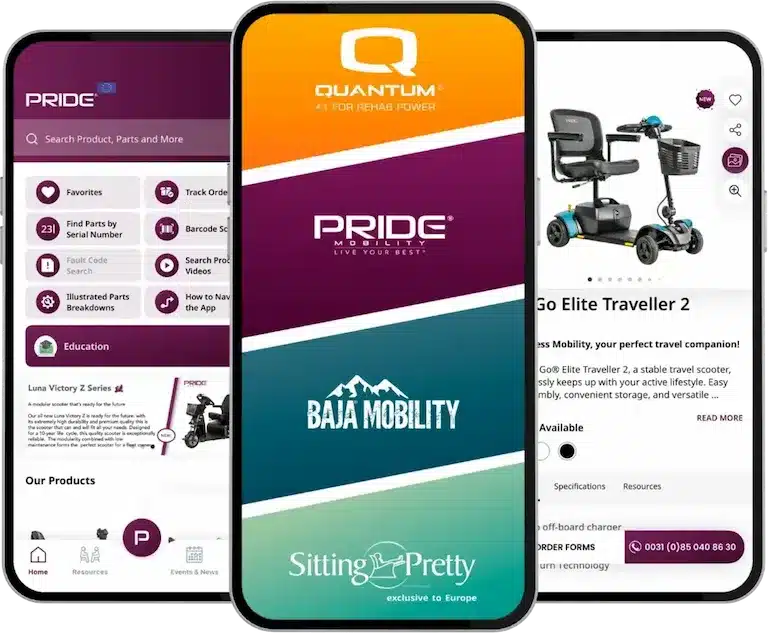
Get instant access to products, manuals, order tracking, and more with the PQ-365 app. Download the Pride Mobility app today.