Power Chairs

Categories

Subscribe to our newsletter

"*" indicates required fields

This field is for validation purposes and should be left unchanged.
I accept the privacy policy*

This site is protected by reCAPTCHA and the Google Privacy Policy and Terms of Service apply.

Looking for more information?

Take a look at our FAQ. We’ve got plenty of helpful tips and answers waiting for you.

Categories

Mobility Scooters

Charging your mobility scooter or power chair

Most mobility scooters and power chairs use two long-lasting, sealed, deep-cycle batteries. These batteries are maintenance-free, so you do not need to check electrolyte levels.

Deep-cycle batteries are designed for longer and deeper discharges than standard vehicle batteries. Vehicle batteries are not suitable for mobility devices because they are not designed to handle extended use and deep discharges.

For optimal performance and longevity:

  • Always use two batteries of the same type, chemistry, and amp-hour (Ah) rating.

  • Use the charger provided with your mobility device, as it is designed specifically for safe, efficient charging.

Off-Board Charging

Most mobility devices use off-board chargers, which are separate from the scooter or power chair. To charge safely:

  1. Position your mobility device next to a standard electrical outlet.

  2. Make sure the controller is turned off.

  3. Plug the charger into the device’s charging socket.

  4. Plug the charger into the electrical outlet.

  5. When the batteries are fully charged, unplug the charger first from the outlet, then from the device.

Many chargers have LED indicators showing power on, charging in progress, or charging complete. If your device does not fully charge within 24 hours, unplug the charger and contact your dealer.

Breaking In New Batteries

New batteries require a few charging cycles to achieve peak performance and long life:

  1. Fully charge any new battery before initial use to reach approximately 90% of its capacity.

  2. Operate the device slowly at first, indoors or in a safe area, to break in the batteries.

  3. Recharge fully for 8–14 hours and use again.

  4. After 4–5 charging cycles, your batteries should reach 100% capacity and deliver maximum performance.

Charging Frequency

How often you charge depends on usage:

  • Daily users: Charge the batteries after each day’s use for 8–14 hours.

  • Occasional users: Charge twice a week for 8–14 hours to maintain battery health.

  • Do not exceed 14 hours of continuous charging to avoid overcharging.

Following these guidelines ensures your mobility scooter or power chair maintains peak performance and extends battery life.

General

Mobility Scooter vs. Power Chair

One of the biggest differences between a scooter and a power chair is how they are operated. Mobility scooters are equipped with a tiller and handle bars, as opposed to a power chair, which is operated using a joystick. Your range of mobility in operating a device may indicate whether a scooter or power chair is best for you. Another difference is the number of wheels they have. An electric scooter typically has three or four wheels, whereas an electric wheelchair typically has six wheels or more. Most power chairs have two large drive wheels and four smaller wheels called casters for added stability. Power chairs come standard with captain’s style seating and there may be optional seating available, such as a solid seat pan or a Synergy® seat. The Jazzy Air 2 Power Chair offers a few seating options to choose from. Scooters usually come with standard vinyl seating, although the seat can be adjusted and may be able to swivel, such as the Victory® 10 DX mobility scooter.

When it comes to comfort, power chairs are equipped with a height-adjustable foot platform that can flip up when not in use. Legroom on a scooter can vary depending on the type of mobility scooter chosen. A three-wheel mobility scooter offers more legroom for taller individuals, while a four-wheel mobility scooter is equipped with a broader wheelbase to ensure even weight distribution for stability.[/vc_column_text][vc_single_image image=”30072″ img_size=”full” el_class=”images-radius”][vc_column_text]To determine whether you need a motorized wheelchair or an electric scooter, ask yourself where the mobility product will be used. While many motorized scooters and electric wheelchairs can be used both indoors and out, power chairs offer more maneuverability indoors. With its foldable design, the i-Go+ Power Chair is extremely compact and maneuverable. In contrast, many mobility scooters are more rugged and designed for outdoor use, such as the Revo™ 2.0 mobility scooter, which is equipped with suspension components for navigating varied terrain. Another point to consider when choosing between a mobility scooter or a power chair is your method of paying for the mobility device. The reimbursement system in your country may cover a portion of the cost of a power mobility device for use in your home, providing it is shown to be medically necessary.[/vc_column_text][vc_empty_space height=”30px”][/vc_column][/vc_row]

What are you looking for?

Cannot find what you are looking for?
View our Product range.

What are you looking for?

Cannot find what you are looking for?
View our Product range.

PQ-365 App

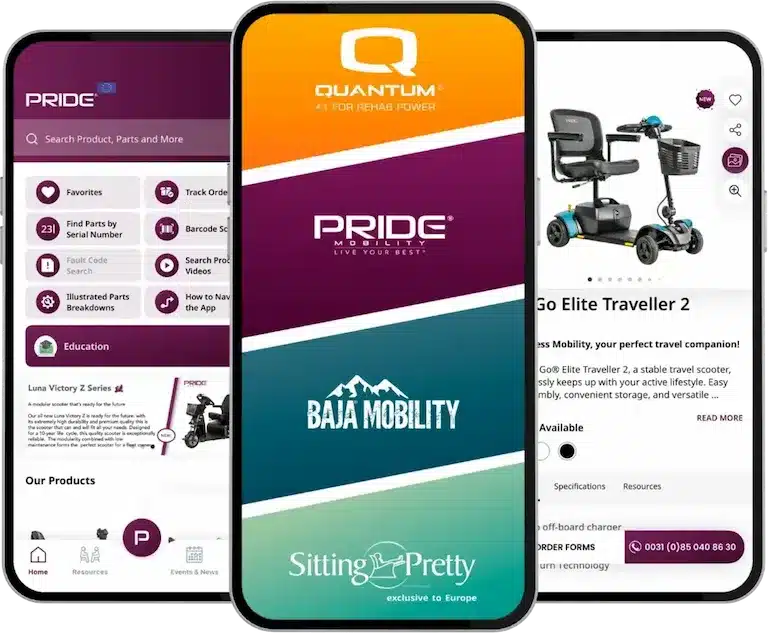
Get instant access to products, manuals, order tracking, and more with the PQ-365 app. Download the Pride Mobility app today.

This site is registered on wpml.org as a development site. Switch to a production site key to remove this banner.